
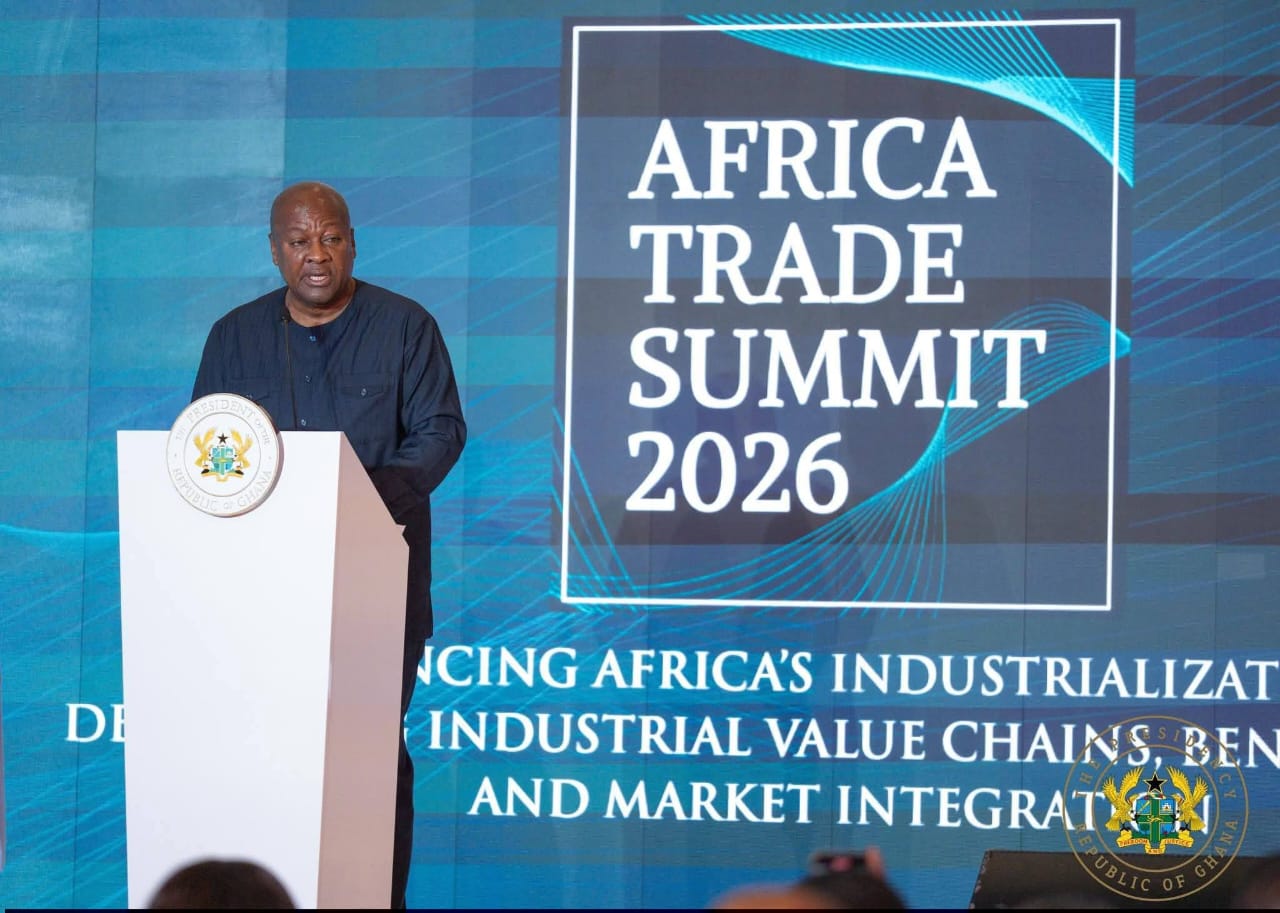
President John Dramani Mahama has renewed calls for a fundamental shift in Africa’s economic model, urging leaders on the continent to abandon the long-standing practice of exporting raw materials and instead prioritise value addition, industrialisation, and market integration as pathways to sustainable growth.

Speaking at the Africa Trade Summit held under the theme “Financing Africa’s Industrialisation: Developing Industrial Value Chains, Beneficiation, and Market Integration,” President Mahama warned that Africa’s continued dependence on primary commodity exports has entrenched underdevelopment and denied its people the full benefits of the continent’s vast natural wealth.
Developing his argument, President Mahama said the current model of exporting unprocessed resources while importing finished goods represents a structural imbalance that must be confronted if Africa is to achieve real economic independence.
“We can no longer accept an economic model that consigns Africa to exporting raw materials and importing finished goods. That model is a new colonial arrangement designed to trap Africa in poverty. Political independence without economic transformation leaves our people vulnerable and our economies exposed,” he stated.
He stressed that this pattern has weakened Africa’s industrial base, drained employment opportunities, and limited technology transfer, noting that meaningful development can only occur when African countries process what they produce and manufacture what they consume.
President Mahama pointed out that the export of unprocessed commodities continues to cost African economies billions of dollars in lost revenue and millions of jobs, while reinforcing dependence on external markets.
“Manufacturing and agro-processing create jobs, raise incomes, deepen skills, and anchor inclusive growth. As long as we remain exporters of raw materials, we will continue to export jobs and import unemployment,” he said.
According to him, reversing this trend requires deliberate policies that promote local processing, industrial value chains, and stronger regional markets capable of absorbing African-made goods.
Using cocoa as a practical illustration, President Mahama highlighted what he described as one of the most glaring examples of Africa’s disadvantage in global trade, despite being a leading producer of key commodities.
“Africa produces most of the world’s cocoa, yet it captures only a small fraction of the value of the global chocolate market. This is a clear demonstration of how value addition determines who benefits most from global trade,” he noted.
He argued that exporting raw cocoa beans while importing finished chocolate products undermines job creation, stifles local enterprise, and weakens the continent’s bargaining power in international markets.
President Mahama further explained that increasing local processing of cocoa and other agricultural commodities would not only boost incomes for farmers but also stimulate industrial growth and create opportunities across the entire value chain.
Turning to Ghana’s mineral sector, the President cited reforms in gold exports as an example of how stronger state control and beneficiation can improve transparency and foreign exchange inflows.
“The establishment of the Ghana Goldbod has significantly strengthened our control over gold exports, particularly from the small-scale mining sector. It has improved oversight, transparency, and foreign exchange management,” he said. President Mahama revealed that although gold exports from the small-scale mining sector in 2024 were projected at 63 tonnes, Ghana did not receive the full foreign exchange proceeds from those exports, underscoring the need for tighter regulation and value retention.
He maintained that Africa’s mineral wealth must be leveraged to support domestic industrialisation rather than enriching external actors at the expense of local communities.
“This is not just about exporting minerals; it is about ensuring that the wealth generated from our natural resources remains within our economies and translates into jobs, infrastructure, and better living standards for our people,” President Mahama stated.
He added that beneficiation and local processing must become central pillars of Africa’s industrial strategy if the continent is to achieve inclusive and resilient growth.
President Mahama concluded by urging African leaders, policymakers, and investors to commit to coordinated action that supports industrial value chains, regional integration, and financing mechanisms that prioritise production over extraction.
“Africa’s future lies in what we produce, how we process it, and how we trade among ourselves. Ending raw material exports is not a slogan; it is an economic necessity,” he said.
Read also…
Only 44% of Ghanaians have access to safely managed water – Works and Housing Minister
Click on the link to join the OnlineTimesGH News channel for curated, meaningful stories tailored just for
YOU: https://whatsapp.com/channel/0029VajF89Q6WaKprDT5mu2V
By Bawa Musah
About The Author


