
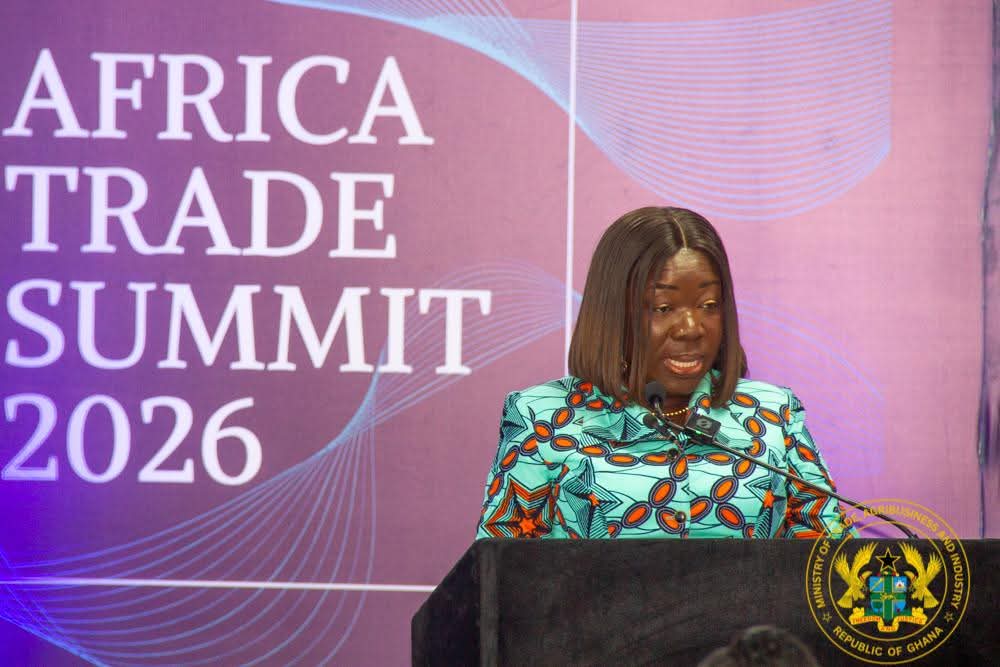
The Minister for Trade, Agribusiness and Industry, Hon. Elizabeth Ofosu-Adjare, has called on African countries to take full responsibility for financing their industrial development, warning that the continent cannot achieve sustainable transformation if it continues to rely on external aid.

Speaking at the Africa Trade Summit in Accra, the Minister said Africa’s industrial future must be anchored on deliberate policy choices, strong domestic financing mechanisms, and long-term planning tailored to the continent’s own realities.
According to her, decades of aid dependence have failed to deliver the scale of industrial growth needed to absorb Africa’s youthful population and reduce poverty, making it imperative for governments to rethink how industrialisation is funded.
She noted that Africa must move beyond rhetoric and adopt sector-focused strategies that prioritise value addition, manufacturing, and agro-processing, backed by patient capital and coordinated public support.
“Africa cannot industrialise on goodwill and promises alone. We must mobilise our own resources, strengthen our domestic financial systems, and deliberately channel investment into priority sectors that can drive productivity and decent job creation. History shows us clearly that no country has industrialised by waiting for aid. Those who succeeded did so by making tough choices, planning for the long term, and backing industry with real financial commitment,” the Minister said.
Hon. Ofosu-Adjare stressed that successful industrialisation across the world has always involved an active state that provides direction, incentives, and strategic support, particularly at the early stages of industrial growth.
She explained that Africa must therefore embrace innovative financing models, including blended finance, development finance institutions, and public-private partnerships, to crowd in private capital while reducing risk for investors.
“The role of the state is not to replace the private sector but to enable it. Governments must provide the right policy environment, infrastructure, and targeted incentives that make industrial investment attractive and viable. Blended finance allows us to de-risk strategic sectors and ensure that private capital flows into areas that are critical for national and continental development,” she stated.
Using Ghana as an example, the Minister said the country’s industrial agenda is guided by a broader vision that goes beyond isolated projects to building competitive value chains capable of serving both domestic and regional markets.
She pointed to government support for manufacturing initiatives, including garment and textile production, as part of a wider effort to promote value addition, reduce imports, and strengthen local industry.
“When we support a garment factory, it is not just about producing clothes. It is about building an ecosystem that creates jobs, transfers skills, supports local suppliers, and positions Ghana to compete effectively within Africa and beyond. Industrialisation must be seen as a system, not a single factory or intervention,” Hon. Ofosu-Adjare said.
The Minister further emphasised the importance of regional coordination, noting that fragmented national approaches will limit Africa’s industrial potential.
She said the African Continental Free Trade Area (AfCFTA) provides a unique opportunity for countries to align industrial policies, build regional value chains, and leverage larger markets to attract investment.
“Our industrial strategies must speak to each other. AfCFTA gives us the platform to think beyond national borders and design industries that can serve a continental market of over a billion people. If we get this right, Africa can move from being a supplier of raw materials to a competitive producer of manufactured goods,” she added.
Hon. Ofosu-Adjare concluded by calling for transparency, accountability, and strong institutions to ensure that resources mobilised for industrial development are used effectively, stressing that Africa’s industrial future depends on bold leadership and collective action, not aid dependency.
By Bawa Musah
Read also…
Click on the link to join the OnlineTimesGH News channel for curated, meaningful stories tailored just for
YOU: https://whatsapp.com/channel/0029VajF89Q6WaKprDT5mu2V
By Bawa Musah
About The Author


