
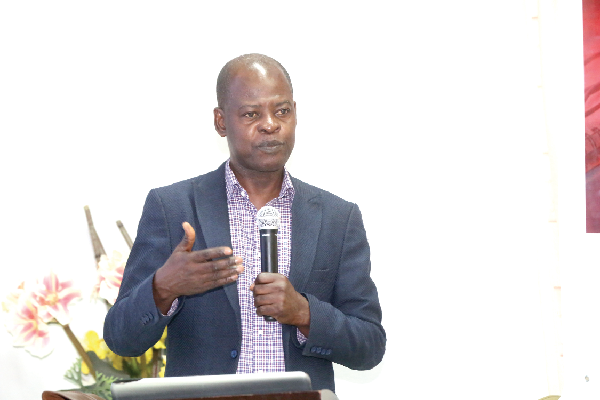
The Ghana Extractive Industries Transparency Initiative (GHEITI) has called on government to completely withdraw the Growth and Sustainability Levy (GSL), warning that maintaining the levy alongside the newly introduced mineral royalty regime could place an unprecedented financial burden on the mining sector.

In a press statement issued on March 13, and signed by Steve Manteaw, Co-Chair of GHEITI, said while it supports the principle behind the government’s new sliding-scale mineral royalty system, the continued application of the levy could significantly raise the overall fiscal pressure on mining companies operating in Ghana.
According to the initiative, the Growth and Sustainability Levy currently stand at three percent of gross production and is not tax-deductible. When expressed in royalty-equivalent terms, it translates to roughly 4.6 per cent.
“The continued application of the GSL alongside the new royalty regime would significantly increase the fiscal burden on gross production, raising it to over 16 per cent, a level that is unprecedented in global mining fiscal regimes,” GHEITI said.
The organisation warned that such a high combined fiscal load could undermine the competitiveness of Ghana’s mining sector and potentially affect investment decisions.
GHEITI noted that fiscal predictability and certainty remain critical factors for mining companies when making long-term investment decisions.
“The biggest threat to Ghana’s investment attractiveness is not necessarily the newly prescribed mineral royalty, but fiscal predictability and certainty, which are essential for long-term planning,” the statement said.
The transparency initiative also pointed to the sudden introduction of the Growth and Sustainability Levy without prior industry consultation, describing it as disruptive to corporate investment planning.
The statement comes amid ongoing national discussions about the government’s newly introduced mineral royalty sliding-scale system, which links royalty payments to fluctuations in gold prices.
Under the new regime, royalty rates will range between five and twelve per cent depending on global gold prices. The lowest rate of five per cent applies when gold prices are around $1,900 per ounce, while the highest band of twelve per cent applies when prices reach about $4,500 per ounce.
While GHEITI described the new royalty framework as fair in principle because it seeks to balance risks and rewards between the state and investors, it acknowledged concerns raised by industry players about how the royalty bands were designed.
The organisation is therefore urging continued dialogue between government and industry stakeholders to ensure the new system achieves its intended objectives without harming the sector’s competitiveness.
“Government and industry must continue engaging to find common ground that advances revenue optimisation while safeguarding the operational sustainability of the mining industry,” the statement noted.
GHEITI also recommended that policymakers explore the possibility of introducing a reduced mineral royalty rate for small-scale miners in order to encourage greater compliance and bring more operators into the formal tax and royalty system.
Click here to read the statement… GHEITI Statement on New Royalty Regime – FINAL_260313_152951
Read also…
Predictability, not royalty, drives Ghana’s mining investment – GHEITI
Click on the link to join the OnlineTimesGH News channel for curated, meaningful stories tailored just for
YOU: https://whatsapp.com/channel/0029VajF89Q6WaKprDT5mu2V
About The Author


